
Architecture and security model
How Signing Server separates requesters, signers, identity, keys and audit, and why a request alone can never produce a signature.
Signing Server is built around a protocol-neutral signing core with adapters at the edge. This page describes the components and the boundaries that every signing operation crosses.
Components
Section titled “Components”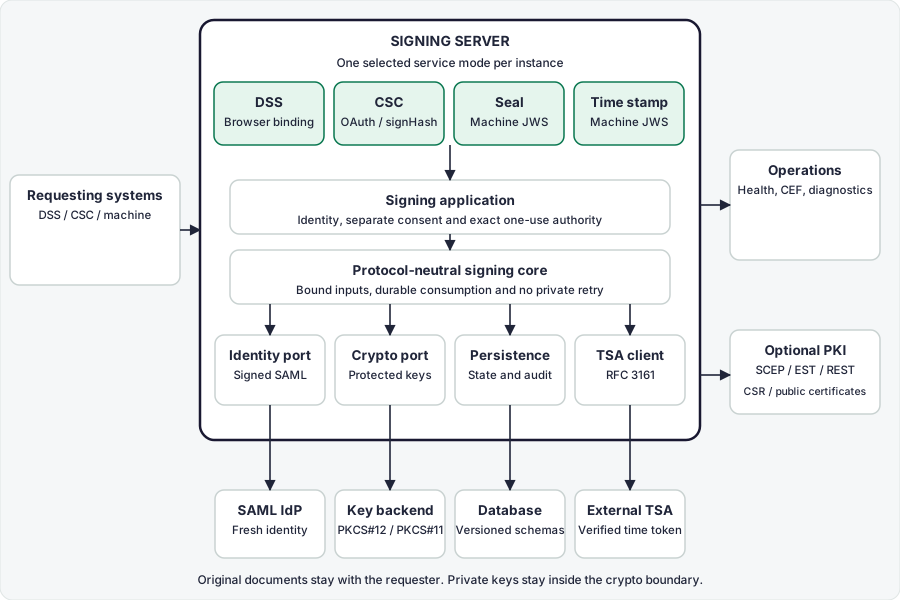
| Component | Role |
|---|---|
| Protocol adapters | Accept requests and map them to the core: DSS (POST/XML/1.0), the separately selected CSC OAuth/signHash subset, and machine APIs for organization seal and time stamping. Protocol types stop here. |
| Signing application | Drives a transaction through request, authentication, consent, authorization and signing. |
| Identity integration | Authenticates the signer through the configured identity provider with signed SAML, and records the signer's separate approval. |
| Crypto backend | Performs the private-key operation in a PKCS#12 keystore or a PKCS#11 token. Private keys never leave it. |
| Persistence | Stores transaction state and audit evidence in PostgreSQL, MariaDB or SQL Server. |
The server is a separate deployable. It has its own listener, database, keys and release cycle, and is consumed by requesting systems over HTTP.
Trust boundaries
Section titled “Trust boundaries”- Requester. DSS and machine requesters authenticate signed messages with registered keys. CSC clients authenticate the relevant OAuth endpoint with a registered
private_key_jwt. Being a trusted requester does not give it the right to sign on behalf of anyone. - Protocol. Size, syntax, algorithms, identifiers, time windows and replay are validated before a request is accepted.
- Identity. An authentication result is accepted only after issuer, audience, time, signer and assurance checks against the administrator's configuration.
- Authorization. Signing authority is bound to one transaction, one signer, one credential and the exact bytes to be signed. It can be consumed once.
- Crypto. The server hands the backend a key reference and receives a signature. The administrator, never the request, selects the key.
- Audit. Only the metadata needed as evidence is stored. Document content, tokens, PINs and keys are never logged or persisted.
Authentication is not consent
Section titled “Authentication is not consent”A human document signature requires two independent facts: the signer explicitly approved the displayed message, and the signer was freshly authenticated. Neither one alone grants authority, and a requesting system cannot supply either on the signer's behalf.
For DSS, the message is displayed in one of two modes, selected by the administrator for each connection and never by a request:
| Mode | Behavior |
|---|---|
idp (default) |
The identity provider displays the message and validates the digest of what was approved. |
signing_service |
Signing Server displays the original message and collects the approval before handing over to the identity provider, which authenticates without a message. |
There is no fallback between the two modes. CSC uses its separate browser consent after verified SAML identity, with distinct service-access and exact signing approvals. Organization seals and time stamps use machine authorization without a human ceremony.
Failure behavior
Section titled “Failure behavior”Replayed, expired, altered or mismatched requests are rejected. Authority is consumed durably before the private-key operation, so a restart cannot make a consumed authorization usable again. If the outcome is uncertain, for example because the result was lost on its way back, the transaction stays consumed and the requesting system must reconcile the known outcome before deciding whether a new transaction is needed. A new transaction requires fresh authorization.
TLS, SAML signing, SAML decryption, the DSS response envelope and the document signing key are different keys with different roles. Startup verifies that they are distinct and that certificates, chains and usage are consistent before the listener binds. The operator supplies transport and envelope keys. Optional external PKI can generate a protected document key and CSR; dynamic person signing does so after verified identification, once per transaction. See External PKI and certificate issuance.